

Writing about debt, especially American debt, is a swampy terrain that could lead us to create a multi-volume encyclopedia because there are many aspects to consider, a lot of information overload, and a turbulent landscape that surrounds us.
At most, considering that our format is a post (more or les a long one), we aim for a didactic summary or, in other words, a description of how debt works with an explanatory approach designed so that anyone can understand it, know how it connects with fiscal or financial policy, with technology, with geopolitics, and how its history influences it through how it has been structured over time and how the parts have interrelated, within and beyond North American borders, because its influence goes beyond its territory.
The aim is to present the perspectives, trends and challenges against a backdrop where the international scene is facing a period of uncertainty, not only because of the altered relations caused by Trump, but also because the United States is an essential piece of the puzzle.
What is the United States’ public debt?
The money that the U.S. owes to investors, foreign governments, national or international banks, in addition to internal accounts that the State itself has, such as Social Security, and for which it uses a key instrument as the main source of financing: TREASURY BONDS.
This foundation has allowed the State to cover its (enormous) needs, essentially because these bonds enjoy global confidence and are therefore considered a safe haven for people with money.
Or perhaps it would be better to say that they used to count, because nowadays it’s not so much anymore.
Historical evolution:
Everything is changing, and the consequences of current tensions are leading to global fragility:
-The flap of a butterfly’s wings at one end of the world can cause a hurricane at the other.
That’s why history is essential, and here we go:
Following the debacle of World War II, debt has maintained a relatively favorable relationship with one of the essential macroeconomic indicators: the GDP which representsthe final result of productive activity within a country.
From the 1970s onwards, in the USA debt ceased to be temporary and became a recurring element to cover the increase in military and social spending that was not sustainable due to government revenue because, by political decision, taxes were reduced and, therefore, fiscal deficits occurred repeatedly, exacerbated by critical moments where generating or offering more debt in the market quelled any opposition by raising money for the government coffers.
It would have to be paid for in the future, of course, but, in theory, it wasn’t a problem.
The turning point came in 2007, when the State intervened to prevent a total collapse resulting from mortgages. SUBPRIMES and bank bailouts are being implemented worldwide, along with fiscal stimulus programs and, interestingly, an increase in public spending, to alleviate the situation.
We recommend reading these posts, and in this order:
- WHAT IS THE FINANCIAL SYSTEM?
- THE FINANCIAL CRISIS.
- THE SCANDAL HAS ERUPTED.
- WHO IS WHO?… IN THE FINANCIAL CRISIS.
These are posts we published back then and recently republished on our NEWSLETTER due to the similarity of certain global movements in debt.
At that time, to stabilize the economy, the strategy was to take on more debt.
There are so many coincidences (coincidence doesn’t exist, there is only causality) among the main participants, the beneficiaries, and what resulted from all of that, that one might wonder if that crisis was designed so that everything happened as it did.
However much they present turbulent movements in the global economy as random, there are always reasons. Nothing is accidental, especially when it comes to money and power.
We jump ahead another time and find ourselves ten years later (2017), with the first rise to power of DONALD TRUMP.
Tax cuts are once again another essential point, or in other words, the reduction of income for the State, to which we must add the COVID pandemic.
The debt, which had increased along the way to $20 trillion, reaches over $27 trillion, or in other words, It increased by about 36%., an outrageous amount that for those who defended and defend Trump is not so, although when criticizing his political opponents it is one of the great arguments against him.
Under the presidency of BIDEN From 2021 to 2025, the economy focused on an expansionary policy in infrastructure, support for social programs and technological transition, in addition to the quintessential American hallmark: defense spending.
The debt INCREASE, with a DEBT-TO-GDP RATIO ABOVE 100%.
One might wonder: How is it possible that they don’t raise taxes to finance themselves?
Besides being an unpopular measure, the main reason is that the dollar is the global reserve currency, allowing them to issue debt in their own currency and finance the deficit without immediate risk of default..
Politically, avoiding tax increases seeks to stimulate private investment and maintain economic growth, prioritizing debt sustainability through GDP growth rather than tax revenue.
An important fact that is largely unknown, and not only to American citizens:
Since 1971 the dollar has been a currency not backed by the gold standard, so the FED can issue virtual money in the amounts that this private company deems appropriate, to stimulate investment and maintain economic growth, prioritizing debt sustainability through GDP growth, rather than tax revenue, avoiding unpopular tax increases… although it can also be understood that it can distort the market entirely to its liking.
Yes, you read that right: a private company. And as a private company, it can meet public needs, but… with private interests, like all private companies.
Upon his return in 2025, Trump used a discourse of apparent accountability and controlled spending, but in practice the debt has once again reached stratospheric levels. 37 trillion dollars, an all-time high.
The conclusion is that, regardless of the party in power, in the USA debt growth is accelerated, structural and cross-cutting.
The current situation:
The debt is the highest in history, with interest payments eating up the entire budget and reducing the State’s ability to finance essential services because there is no room for spending.
The risk of DISPLACEMENT EFFECT of private investment is already underway, with the consequent high risk of default or crisis.
If we add to all this the bubble that is being created around DEBT IN AI with enormous public and private outlays, uncertain or very long-term economic returns, it is clear that the deficit is increasing every day and is reaching positions that have long since exceeded the red lines.
The aggressive American foreign policy, seemingly driven by imperialist ambitions, may be more propaganda than anything else and possibly has a different purpose:
- Secure the raw materials needed for AI (rare earths).
- Not to fall behind in the dominance of trade routes.
- Energy control (oil, gas and electricity).
- Internal revenues transferring what should be that internal fiscal policy to the rest of the countries with tariffs in continuous fluctuation.
Furthermore, this ongoing dispute with the international order requires a permanent military presence, which entails an additional expense.
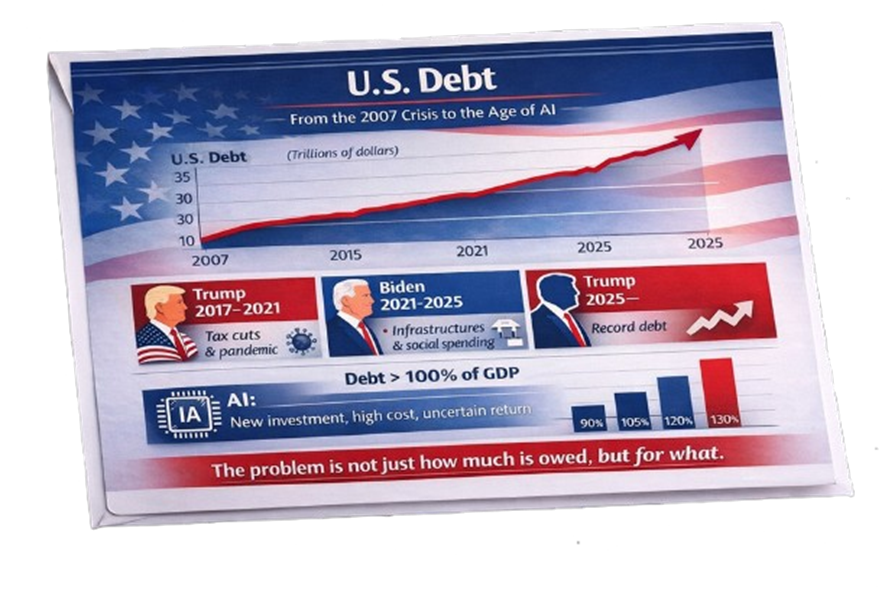
And as the final phrase in the previous image says:
-The problem is not just how much is owed, but what for.
Where could all this end?
Confidence is crumbling and the dollar is losing strength against other currencies, because the debt buyer feels uneasy and prefers to take refuge in other safer niches, or in other words, the dollar is losing not only confidence but also acceptance as a reference currency.
If the USA has used the dollar as a political weapon until now, its pillars may be threatened because with the DE-DOLLARIZATION going into debt can be much more expensive.
If other countries sell their American debt, the US government will seek more investment to pay increasingly higher interest rates, producing a SNOWBALL effect.
In the end, it’s a vicious cycle, and no matter how meticulously designed the actions are – even if they publicly appear to be the result of whims – if income does not exceed expenses, the system can collapse.
American debt is not a current problem; it is the consequence of more than 80 years of structural deficit that had been covered up by kicking the can down the road.
We can advertise, again and again, that we have to make America great again… yes, an excellent slogan, but shouldn’t we negotiate and reach the best agreements with the rest of the countries?
Otherwise, catastrophe is inevitable.
The borrowing capacity, based until now on the size of its economy, the dominance of the dollar, and global confidence, with which wars, crises, and internal or external adjustments have been financed, in addition to a world leadership based on trade, investment, innovation, and internal growth, is being exhausted because the borrowing capacity is not unlimited, and furthermore, the expansionist policy, although intended to nourish the country in exchange for others, is straining everything.
Expanding militarily, economically, or technologically only makes sense if the revenues exceed the costs, but spending on defense and global security is not generating direct growth.
Sanctions, trade wars, or tariffs, even against partner countries, reduce trade rather than expand it.
The dollar, we repeat, is becoming discredited as a reference currency, weakening progressively.
Therefore, what was once a dominant power is now a defensive power, with the possibility of alternative financial systems being created outside the dollar, and in a climate of confrontation, REJECTION CASES could occur, this is already happening, with Danish, Swedish, and Finnish investment and pension funds reducing their debt positions in the US.
In summary:
The United States, like those who bought homes with subprime mortgages without having the money to repay them, has lived beyond its means for decades, and it seems that debt crises may force historic decisions involving:
- Paying interest and debt by reducing social spending or investment.
- Accepting the loss of global influence.
- Redefining military commitments and alliances.
- Redistributing the adjustment costs internally among the Americans themselves.
The shock wouldn’t be limited to home soil:
-A single drop of poison clouds the ocean.
It would be the same effect as when there is a systemic collapse of organs in a damaged or diseased body.
Some solutions include:
- Eliminate economic or strategic commitments to prioritize fixing domestic problems.
- Invest only in what is profitable in the short term, with measurable and real returns, so that, for example, technology and defense take a secondary role.
- Increase the tax burden, despite the political backlash, by making a much more equitable distribution of wealth.
- Restore international trust by reducing belligerent noise.
- Reinterpreting what leadership means, not focusing so much on personal branding, but on a more cooperative economy where every part counts in providing solutions, and not just focusing on the State as a business.
Of course, you can continue in the same vein, and in that case we recommend watching a film by STANLEY KUBRICK: DR. STRANGELOVE OR: HOW I LEARNED TO STOP WORRYING AND LOVE THE BOMB
As an interesting side note: While searching for an image to illustrate this article, we used an AI, and in the prompt, in addition to specifying that the image should allude to the current moment, the word “spectacle” slipped in, and this was the result:
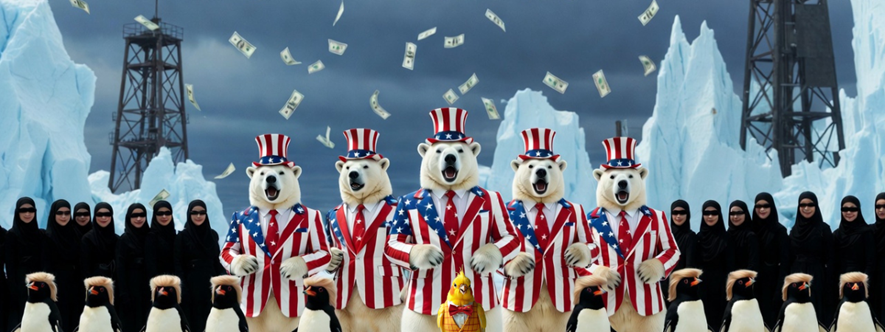
The American debt spectacle – Satur Dopar | Grok
A true homage to classic musicals, this production features not swimmers or dancers with spectacular legs, but rather Asian women (dressed in period style) in the dance troupe, with penguins paying tribute to the president, and the Star-Spangled Banner as the main protagonists. The set design is absolutely marvelous: oil wells, ice formations that surely conceal rare earth elements, and banknotes flying everywhere. Note the detail of the canary in a bow tie. It might seem like an intruder… or not.
*This post is owned by TODO ES SINGULAR, SL (https://todoessingular.com/en/) and the information contained herein may be used by third parties with the express written authorization of the source.


